

Hurricane cash flow planning turns Florida storm risk into numbers you can manage. A strong plan does more than park money in an emergency account. It shows when cash comes in, what must still be paid during a closure, and how long the business can operate if revenue slows or stops.
Start with Advanced CFO’s mid-year financial review and hurricane plan to identify the broad risks facing your business before storm season arrives. Then build a weekly forecast that tests your actual payroll, receivables, vendor commitments, debt payments, insurance deductibles, and recovery costs against several shutdown scenarios. A bank balance is a snapshot. A forecast tells you when the pressure arrives.
What Hurricane Cash Flow Planning Must Cover
Hurricane cash flow planning is a financial stress test, not a generic emergency checklist. A checklist tells you to save receipts and back up files. A real plan connects operating cash, expected collections, payroll, vendor obligations, taxes, debt payments, insurance deductibles, emergency purchases, and recovery timing into one weekly view. That connection matters because a storm rarely hits one part of the business at a time. It slows collections, delays vendor deliveries, and pauses revenue all at once, and a plan built around a single number cannot show how those pressures interact.
Build a Rolling 13-Week Cash Flow Forecast
A monthly budget cannot keep pace with a storm. Conditions can change within days, and a forecast built around 30-day buckets hides the exact week when cash gets tight. A rolling 13-week cash flow forecast solves that problem by breaking the quarter into weekly columns so owners can see pressure building before it becomes a crisis.
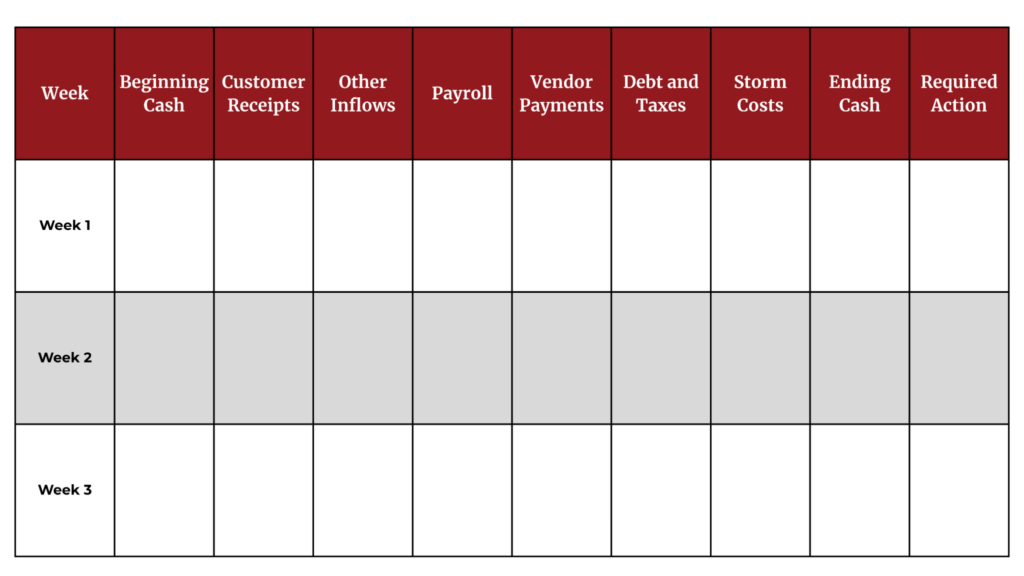
For each week, list beginning cash, expected customer receipts, other inflows, payroll, vendor payments, debt and tax obligations, storm-related costs, and ending cash. Update the forecast with actual results every week rather than treating it as a one-time exercise. Advanced CFO’s small business cash flow management guide walks through the same weekly discipline for everyday operations, and the hurricane version simply layers storm assumptions on top of that baseline.
A simple version of the forecast might look like this:
Stress-Test Three Hurricane Disruption Scenarios
Once the weekly forecast exists, run it against three realistic scenarios: a three-day interruption, a two-week shutdown, and a 30-day recovery period with reduced revenue. In each case, collections often slow even though invoices remain open, since customers facing their own storm damage may delay payment regardless of terms. Payroll, rent, insurance, subscriptions, debt service, and essential vendor payments continue on schedule no matter which scenario plays out.
Compare the weekly ending cash across all three scenarios side by side, then identify the first week in each case where ending cash falls below management’s minimum threshold. That single data point, the week cash turns negative or unacceptably low, is the most useful output of the entire exercise, because it tells the owner exactly how much time exists before a decision becomes forced rather than planned.
Protect Payroll, AP, and AR During a Disruption
Cash flow protection during a storm comes down to keeping three functions moving: payroll, accounts payable, and accounts receivable. Confirm remote approval access for payroll well before hurricane season, since an approver stuck without power or connectivity can stall an entire pay cycle. Payroll services from Accupay can support payroll continuity when the physical office is unavailable, keeping wage payments on schedule even during a closure.
On the collections side, confirm which customer payment methods still work during an outage and assign clear collection responsibilities so receivables do not stall simply because no one owns the follow-up. Advanced CFO’s accounts payable and accounts receivable cash flow guide covers payment timing and prioritization in more depth, including how to sequence vendor payments when cash is tight. Access to current financial data matters just as much as the plan itself, and cloud accounting packages give the finance team a way to review balances, payables, and receivables from anywhere the office is unreachable.
Set Cash Triggers and Backup Funding Before a Storm

A forecast only helps if it triggers action. Set specific triggers before hurricane season, such as ending cash dropping below one full payroll cycle, receivables aging well beyond normal terms, or forecasted cash falling below the insurance deductible amount. Match each trigger to an approved action in advance: accelerating collections, postponing discretionary spending, drawing on an existing credit line, or revising vendor payment timing.
Confirm any financing, including lines of credit, before storm season begins rather than assuming it will be available afterward. Lenders slow down during widespread regional disasters, and a credit line that has not been reviewed recently may carry lower availability than expected.
Frequently Asked Questions About Hurricane Cash Flow Planning
How much cash should a Florida business keep for hurricane season?
No single reserve percentage fits every company. Start with fixed weekly obligations, including payroll, debt, rent, insurance, critical vendors, and taxes. Then add the likely cost of your deductible and temporary operations. Model at least a short closure and a slower recovery, and set the reserve from those scenarios.
What goes into a 13-week hurricane cash flow forecast?
A 13-week forecast lists expected weekly cash inflows, required outflows, beginning cash, and ending cash. For hurricane planning, add reduced collections, closure-related revenue loss, payroll, emergency purchases, insurance deductibles, cleanup costs, and payment timing. Update actual results weekly so management can see changes early.
Should payroll be included in a hurricane cash reserve?
Yes. Payroll is often one of the largest near-term obligations and may continue even when operations are interrupted. Model regular payroll, payroll taxes, benefits, overtime, and any owner decisions about paid closure time. Confirm remote approval access and discuss wage obligations with qualified employment counsel.
What is the difference between a cash reserve and a line of credit?
A cash reserve is money already available, while a line of credit is borrowed liquidity subject to lender terms and availability. A sound plan may use both, but owners should not assume financing will be approved after a storm. Confirm borrowing capacity before hurricane season and model repayment costs.
How can a fractional CFO help with hurricane planning?
A fractional CFO turns operating risks into forecast assumptions, tests multiple shutdown and recovery scenarios, and identifies when cash could fall below a safe level. The CFO can also help set decision triggers for collections, vendor payments, spending, and financing so the owner is not improvising under pressure.

Build Liquidity Before the Forecast Turns Red
Florida businesses cannot control a storm’s path, but they can control the quality of their numbers. A 13-week forecast gives owners enough detail to protect payroll, manage collections and payments, and act before cash drops below a safe threshold.
If your current forecast cannot show the cost of a one-day, two-week, or 30-day disruption, Advanced CFO can build it into your CFO advisory plan. Pair that financial model with reliable remote payroll services from Accupay so the people side of the plan keeps running when the office cannot.